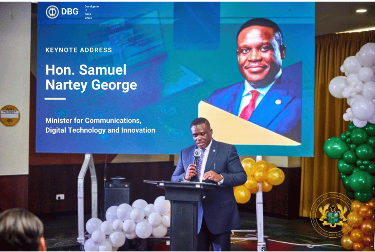
Ghana’s Minister of Communications and Digitalisation, Samuel George has called on banks, private investors and financial institutions to create new flexible financing options to support the rapid growth of the country’s Information and Communications Technology (ICT) sector.
Speaking at the Development Bank Ghana (DBG) ICT Sector Financing Roundtable in Accra held under the theme “From Connectivity to Capital: Financing Ghana’s Digital Future” the Minister emphasized that standard commercial bank loans are no longer suitable for the fast-changing needs of tech startups and digital infrastructure projects.
During the event, government officials and tech entrepreneurs addressed the major financial barriers holding back local tech companies. Traditional commercial banks in Ghana typically require heavy physical collateral, such as land or buildings, alongside high interest rates that make borrowing unviable for asset-light technology firms.
To bridge this gap, the Minister urged banks and investors to try new ways of giving out money.
He asked banks to buy shares in tech companies instead of just giving out loans that are hard to pay back. He also suggested using safety nets, where big development banks like DBG help share the risk if a tech business struggles.
Finally, he called on banks to look at a tech company’s software, online customers, and monthly earnings when deciding to lend money rather than always asking for physical land or buildings.
See also: Kenya and Fortinet Team Up to Fight Cyber Crime with Smart AI Technology
The call for new funding structures aligns with Ghana’s broader economic performance, as the ICT sector expanded by 30.9% in the second quarter of 2026, making it one of the main drivers of national economic growth.
Development Bank Ghana Chief Executive Officer Kwamina Duker reaffirmed the institution’s commitment to setting up long-term, low-interest wholesale funding channels for commercial lenders.
By unlocking targeted capital, DBG aims to help local tech companies scale operations across West Africa, expand regional broadband infrastructure and solidify Ghana’s position as a regional digital hub.