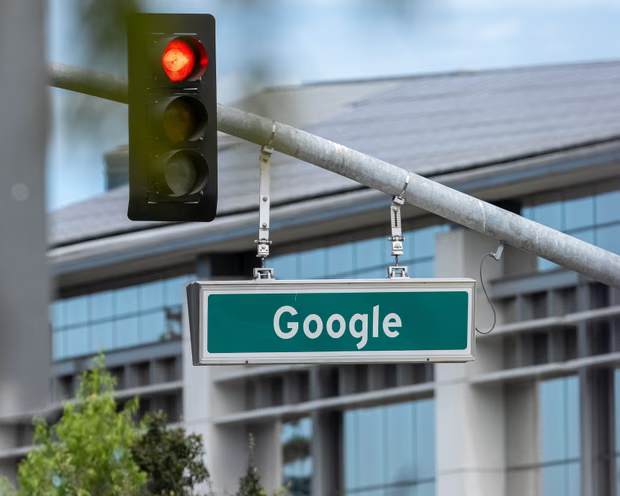
Google must pay a huge €403m fine in Ireland after watchdog officers found it used tricky settings to secretly track mobile phone locations.
Google has received a huge fine of over €403 million, which is around €345 million, from the Data Protection Commission in Ireland.
Official privacy officers punished the company after discovering that Google used clever tricks on mobile phones to trace every step users took without clearly letting them know.
Government watchers explained that when users set up their phones, Google made it confusing for them to turn off location settings.
This secret tracking allowed the search engine to collect sensitive information about where people went every day, including their places of worship, hospitals, and political gatherings.
The legal penalty comes after six long years of investigation started by consumer watch groups across Europe. These group leaders filed official reports showing that Google used deceptive designs to keep location history and app tracking active on phones.
The Irish privacy office ruled that Google broke strict European privacy protection laws between May 2018 and February 2020 by failing to get clear permission from phone owners.
Along with paying the heavy money penalty, Google has been given a firm order to fix its system within six months so users get real control over their private location data.
Explaining why the government took such strong action, Graham Doyle, who serves as a deputy commissioner at the Irish Data Protection Commission, spoke about the danger of hidden phone tracking, saying: “Location data is a type of personal data which is processed by way of location tracking, and includes data collected or processed by Google, which by itself or in conjunction with other information an individual’s location can be inferred. Location data can bring both benefits and harms to individuals. It can greatly enhance the utility of online services, but it can also reveal a significant amount of information about an individual, including inherently private information.”
Doyle further pointed out how users lost control of their personal information, stating: “As a result of Google’s failures in this regard, individuals could have been unaware that their location was being used to, for example, influence them with ads or to infer their interests, and could lose control over their personal data. The retention of users’ location data for longer than necessary aggravated this loss of control.”
Consumer rights advocates who fought for phone owners expressed satisfaction that government officers finally took action.
See Also: X Sues Crypto Influencers for Stealing Money Through Fake Likes and Retweets
Welcoming the outcome of the long investigation, Finn Myrstad, who works as the director of digital policy at the Norwegian Consumer Council, emphasized why clear rules matter for phone users, saying: “Today marks an important milestone in the effort to protect our rights online. People must be able to understand what they are agreeing to without being deceived or manipulated into making choices they otherwise would never have made.”
However, leadership at top European watchdog groups felt the ruling took too long to arrive. Sharing his thoughts on the decision, Agustín Reyna, who serves as director general at the European Consumer Organisation, welcomed the penalty but voiced concern over the delay, stating that “the time needed to come to this conclusion is disproportionate to the seriousness of the infringement” and warning that “late enforcement can be as harmful as no enforcement at all.”
Responding to the massive fine and public criticism, a Google spokesperson defended the company’s current rules, saying: “This case centres around historical policies that have since been updated. From 2019 onwards, we’ve significantly evolved our practices and launched robust tools that make managing location data simple.”
This major penalty serves as a serious lesson for mobile phone users across African nations, including Nigeria, Kenya, and South Africa, where millions of people use Android phones daily.
Tech experts urge phone owners to check their privacy settings regularly and turn off unwanted location sharing, as large tech platforms frequently gather personal movement records for targeted advertising unless users actively stop them.